LNP · 96-well parallel dialysis
High-throughput dialysis for LNPs
Connect formulation screening with parallel ethanol removal and buffer exchange.
LNP (lipid nanoparticle) formulation screening often produces multiple low-volume samples. The Cresivis 96-well parallel dialysis plate brings them into a shared plate workflow for post-formulation ethanol removal, buffer exchange and comparison of dialysis conditions. Suitability for each formulation requires membrane selection and sample-quality validation.
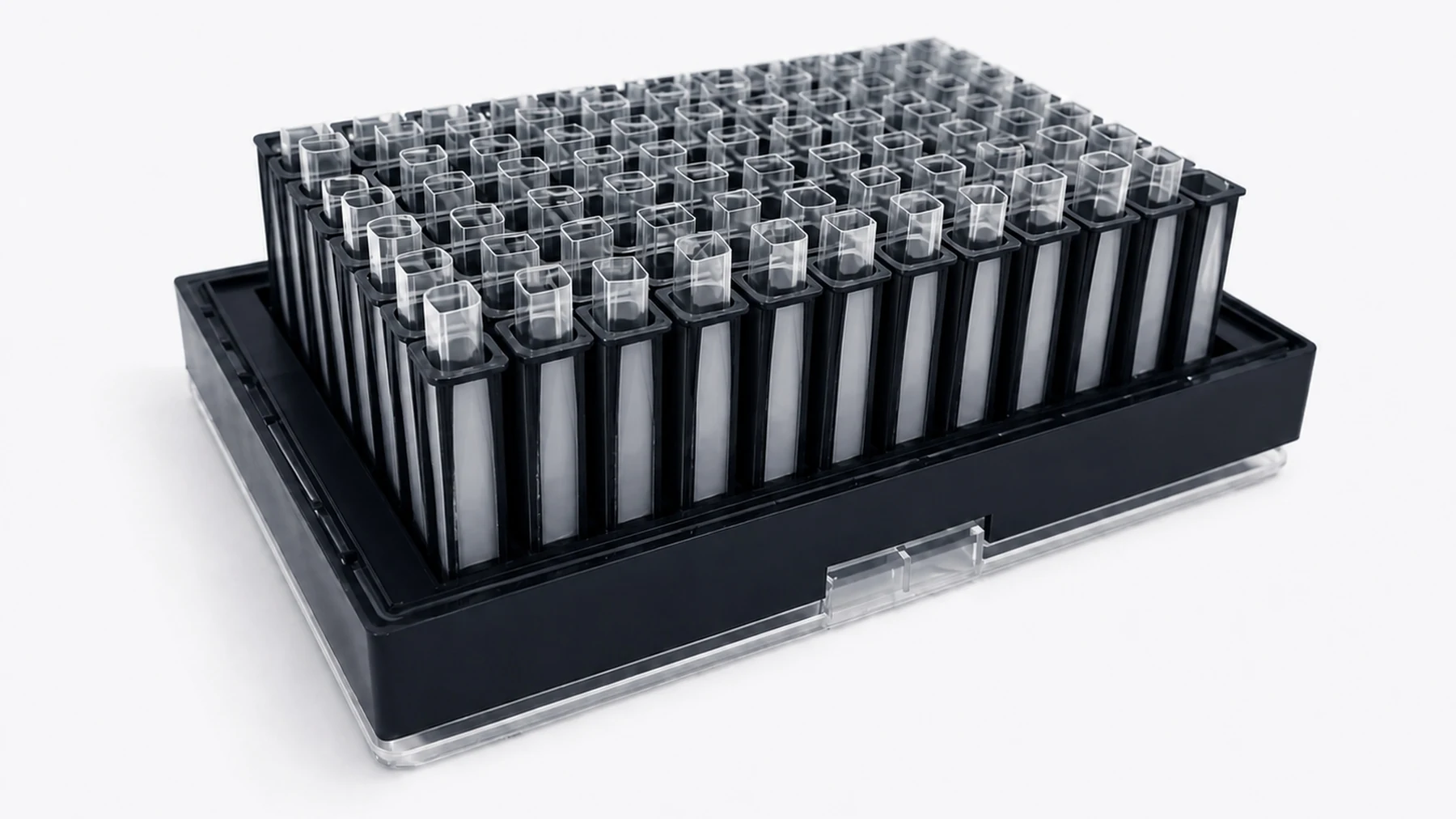
Product specifications for LNP screening
- Parallel samples
- 96 wells; independent loading and sampling
- 25 mm membrane models
- 50–250 μL working volume per well
- 35 mm membrane models
- 50–400 μL working volume per well
- Standard membrane
- Regenerated cellulose (RC), 12 kDa MWCO; application-specific options
- Operating conditions
- 4–50 °C, pH 5–9; actual LNP conditions require separate validation
- Cleanliness and use
- Not sterilized or enzyme-free treated; single use for research and process development
These are product specifications, not validated LNP recovery, encapsulation efficiency or ethanol-removal results. For mRNA / siRNA samples, first confirm nuclease background, material compatibility and sample stability.
Why consider dialysis after LNP formulation?
Dialysis exchanges small molecules between a sample and an external dialysate by diffusion across a membrane. LNP research has used this process to lower residual ethanol and change the buffer before subsequent characterization.
Read a published research example · Nature Communications (2022)
This study provides application context and used other dialysis consumables. Its MWCO, pH, timing and results are not validation data for Cresivis products.
Bring formulations into a comparable processing workflow
- 01
Define the target
Record formulation IDs, volume per well, initial ethanol content, target buffer and processing-time limits. Identify the variables to compare.
- 02
Select and validate
Select membrane length for the working volume, then confirm membrane material, MWCO and container. Follow the product manual for activation and run leakage and representative-sample recovery pilots.
- 03
Load and exchange in parallel
Load through the open wells and keep the active membrane sections immersed. Record temperature, dialysate volume and exchange schedule. Where samples share dialysate, evaluate the influence of components that can cross the membrane.
- 04
Recover and compare quality
Sample from above and compare particle size, PDI, encapsulation efficiency, recovery and residual ethanol before and after treatment. Use measurements to establish the endpoint and acceptable operating conditions.
What should an LNP validation plan measure?
- Ethanol and small-molecule residuals
- Define limits for the intended use and confirm removal with analytical methods appropriate to the sample.
- Particle size and PDI
- Compare distributions before and after dialysis and across wells to assess aggregation, dilution and changes in conditions.
- Encapsulation efficiency and recovery
- Use nucleic-acid or lipid measurements to assess sample loss, with consistent sampling volumes and calculations.
- Buffer conditions and membrane integrity
- Check pH, salt concentration, volume change, leakage and membrane adsorption. Completed buffer exchange alone does not establish that all quality criteria are met.
LNP dialysis questions
How many LNP samples can one plate process?
A Cresivis plate has 96 parallel sample wells for formulations, replicates and controls. Independent sample wells do not imply independent dialysate conditions. Confirm container isolation when comparing different external buffers.
How do I choose between 50–250 μL and 50–400 μL?
Models with 25 mm membranes support 50–250 μL per well; 35 mm models support 50–400 μL. Consider recovery volume, pipetting allowance and swelling during dialysis, and establish the safe loading volume in a pilot.
Is the standard 12 kDa MWCO suitable for every LNP formulation?
No universal suitability is established. MWCO is a membrane separation specification and should not be selected from particle size or payload molecular weight alone. Confirm material, sample composition, adsorption, removal targets and recovery; other membrane or MWCO configurations can be discussed.
Can a formulation in pH 4 buffer be loaded directly?
The released product manual specifies pH 5–9, so pH 4 is outside that range. Discuss material compatibility and the transition from the formulation buffer before confirming use.
How long does ethanol removal or buffer exchange take?
There is no fixed duration for every formulation. Sample volume, initial ethanol content, dialysate volume, exchange method, MWCO and temperature influence the process. Confirm the endpoint using residual measurements and sample quality; the manual’s general exchange schedule does not replace LNP-specific validation.
Can the plate be integrated with a liquid handler?
The plate uses a 96-well interface designed for SBS compatibility, with open loading and sampling from above. Confirm deck placement, tip heights, pipetting paths and speeds, container clearance and dialysate exchange for the specific platform.
Product documents and sources
Product specifications on this page come from the September 2026 Cresivis dialysis plate documents. Application guidance supports pilot planning; the agreed validation results and specification supplied with the product govern the final configuration and performance.
- Product manual (English PDF)
- One-page product sheet (English PDF)
- Payload distribution and capacity of mRNA lipid nanoparticles · Nature Communications (2022)
Cresivis · Page updated:
Tell us about your LNP dialysis requirements
Share volume per well, sample count, initial ethanol content, target buffer, temperature and time constraints, and your particle size / PDI, encapsulation, recovery and residual criteria so we can discuss configuration and validation.
Discuss your LNP workflow